
Quantum Key Distribution
Quantum cryptography, particularly quantum key distribution (QKD), promises information-theoretically secure communication based – in principle – solely on the laws of physics. Nevertheless, making these theoretical concepts work in practice offers a number of challenges.
I am interested in developing general tools for the construction and analysis of information-theoretic security proofs, alongside concrete security proofs for quantum communication protocols. Here, a particular focus is the role of underlying assumptions and their impact on achievable security in realistic implementations, with the aim of identifying assumptions that enable optimal trade-offs between security and practicality.
Additionally, I use cryptographic protocols as tools to investigate fundamental aspects of quantum theory. In particular, I am interested in how structural features such as nonlocality, spacetime constraints, and (quantum) reference frames influence the formulation and analysis of communication protocols, including randomness generation.
Randomness Generation
Randomness is (more or less) part of our daily lives. However, in cryptographic contexts, randomness has a precise meaning that goes beyond everyday intuition, requiring it to be fundamentally unpredictable in a certifiable sense. Quantum mechanics enables the generation of intrinsically unpredictable outcomes, and I study how this fundamental feature can be harnessed to generate and certify randomness.
Quantum Information Theory
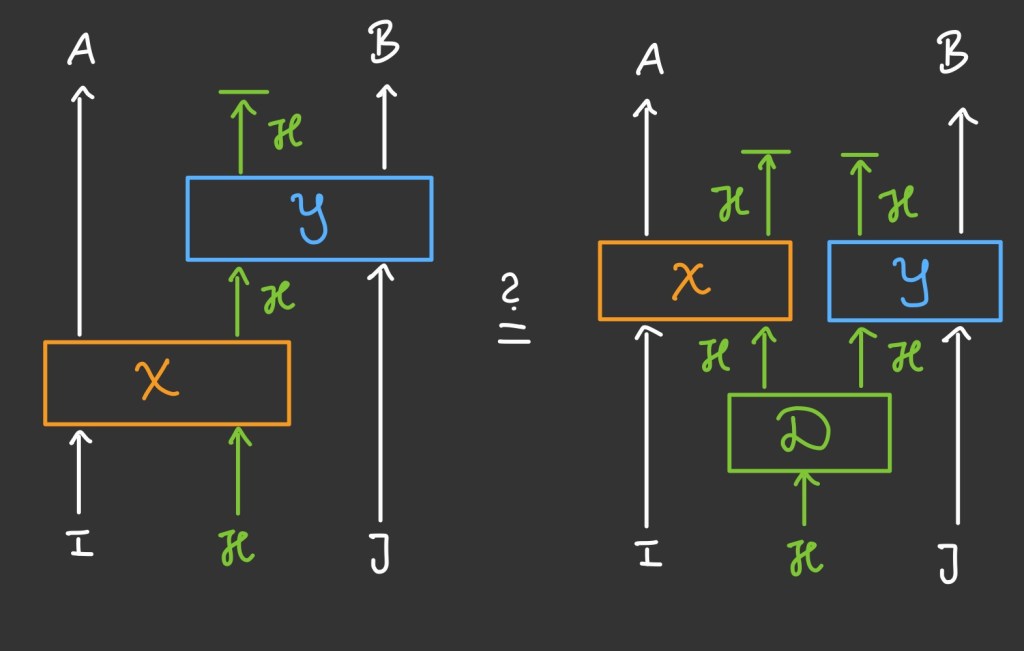
I am generally interested in various aspects of quantum information theory beyond the topics listed above. In particular, I work on the mathematical formalism underlying quantum information theory and its use in describing quantum processes and resources, especially in the context of information-processing protocols. A recurring theme in my research is the role of entropy and other information-theoretic quantities as tools for characterizing and quantifying quantum information.
Fusion Categories and CFTs
I investigate the connection between fusion categories and conformal field theories (CFTs) via lattice models in one and two dimensions. This approach is driven by the question whether there is a CFT associated to a specific fusion category, namely one that arises from the Haagerup subfactor.
If you want to know more about this, you can find my PhD thesis on the arXiv: arXiv:2101.04154


