
Device-independent randomness amplification
with Anatoly Kulikov, Simon Storz, Josua D. Schär, Martin Sandfuchs, Florence Berterottière, Christoph Hellings, Renato Renner, and Andreas Wallraff
The quest for achieving perfect randomness assumes paramount significance across multifarious applications, notably in the realms of cryptography and computational simulations. However, it is not clear that such a resource exists. Conventional random number generators, rooted in classical physical processes, grapple with a foundational concern – the potential for adversaries to predict their outputs by scrutinizing the microscopic degrees of freedom, thereby eroding their essential unpredictability. Fortunately, quantum physics exhibits intrinsic randomness, which opens up the possibility of creating perfect randomness from an imperfect and publicly accessible source. However, since its practical realisation relies on the successful execution of a Bell test with reasonably high Bell violation and repetition rate, it has not been demonstrated – until now.
In this work we combine recent theoretical process on randomness amplification protocols with new experimental developments in Bell tests and report on the first successful demonstration of device-independent randomness amplification. Our demonstration, based on a Bell test with superconducting circuits, marks a significant advancement within the domain of quantum technologies, heralding the ability to weaken the prior necessity for perfect randomness.
ArXiv: 2412.17931
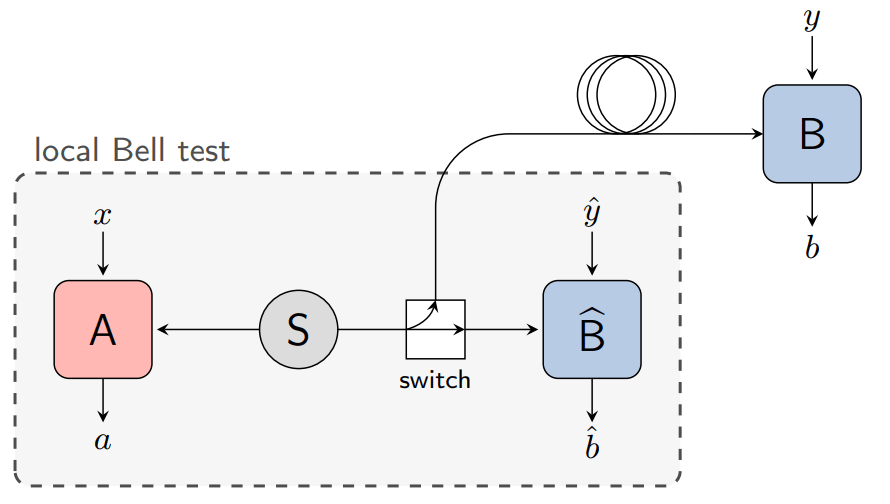
Entropy bounds for device-independent QKD with local Bell test
with Ernest Y.-Z. Tan
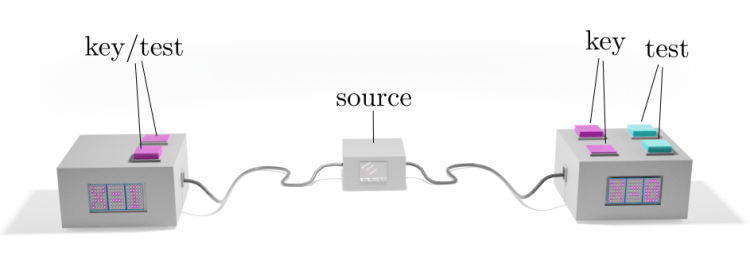
One of the main challenges in device-independent quantum key distribution (DIQKD) is achieving the required Bell violation over long distances, as the channel losses result in low overall detection efficiencies. Recent works have explored the concept of certifying nonlocal correlations over extended distances through the use of a local Bell test. Here, an additional quantum device is placed in close proximity to one party, using short-distance correlations to verify nonlocal behavior at long distances. However, existing works have either not resolved the question of DIQKD security against active attackers in this setup, or used methods that do not yield tight bounds on the keyrates. In this work, we introduce a general formulation of the key rate computation task in this setup that can be combined with recently developed methods for analyzing standard DIQKD. Using this method, we show that if the short-distance devices exhibit sufficiently high detection efficiencies, positive key rates can be achieved in the long-distance branch with lower detection efficiencies as compared to standard DIQKD setups. This highlights the potential for improved performance of DIQKD over extended distances in scenarios where short-distance correlations are leveraged to validate quantum correlations.
Journal: Physical Review Letters 133, 120803 (2024)
ArXiv: 2404.00792
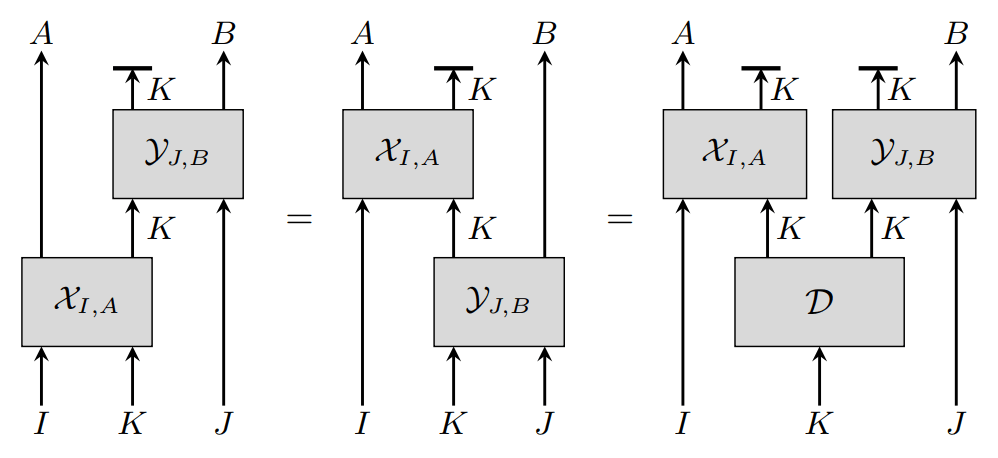
Commuting operations factorise
with Renato Renner
Consider two maps acting on a joint Hilbert space. What properties do they need to exhibit to be able to write them as a tensor product of maps? This can be regarded as a „fully quantum“ version of Tsirelson’s problem, and the answer can be found in our latest work!
ArXiv: 2308.05792

The debate over QKD: A rebuttal to the NSA’s objections
with Renato Renner
A recent publication by the NSA assessing the usability of quantum cryptography has generated significant attention, concluding that this technology is not recommended for use. Here, we reply to this criticism and argue that some of the points raised are unjustified, whereas others are problematic now but can be expected to be resolved in the foreseeable future.
ArXiv: 2307.15116
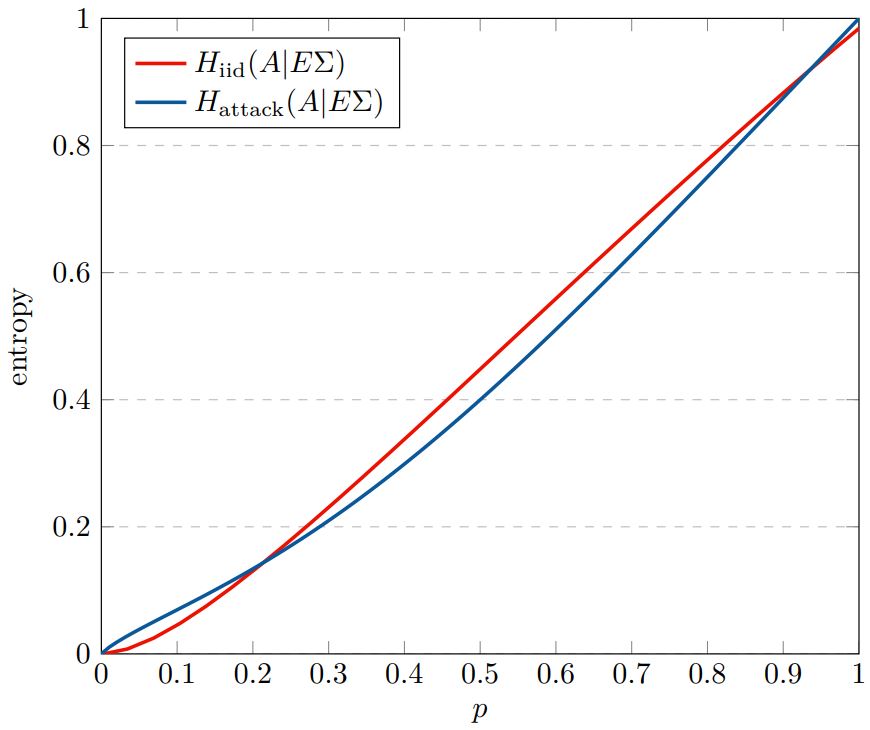
Coherent attacks are stronger than collective attacks on DIQKD with random postselection
with Martin Sandfuchs
In a recent paper, the authors report on the implementation of a device-independent QKD protocol with random postselection, which was originally proposed in this work. Both works only provide a security proof against collective attacks, leaving open the question whether the protocol is secure against coherent attacks. Here, we report on an attack on this protocol that demonstrates that coherent attacks are, in fact, stronger than collective attacks.
ArXiv: 2306.07364
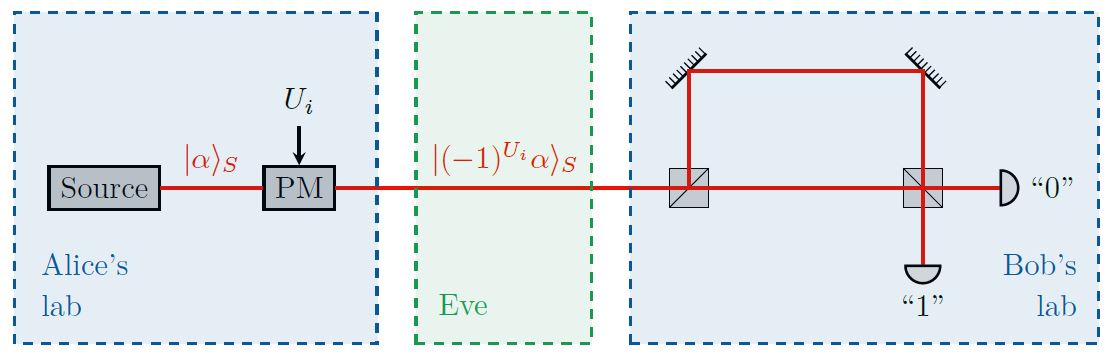
Security of differential phase shift QKD from relativistic principles
with Martin Sandfuchs, Martin Haberland, and V. Vilasini
20 years after its invention, we provide a full security proof of the differential phase shift protocol for quantum key distribution! The proof combines the entropy accumulation theorem with relativistic principles and techniques from quantum optics.
Journal: Quantum 9, 1611 (2025)
ArXiv: 2301.11340

Quantum advantage in cryptography
with Renato Renner
We give an overview of the principles of quantum mechanics that enable information-theoretic security, why quantum cryptography is important, and discuss the state of the art of the field.
Journal: AIAA Journal 61 (5), 1895-1910 (2023)
ArXiv: 2206.04078
Device‑independent quantum key distribution with random key basis
with René Schwonnek, Koon Tong Goh, Ignatius W. Primaatmaja, Ernest Y.-Z. Tan, Valerio Scarani, and Charles C.-W. Lim
We present a simple variant of the original device-independent QKD protocol based on the CHSH inequality that uses for two randomly chosen key generating bases instead of one. This enables positive key rates in the high-noise regimes and significantly narows the gap between theory and experiment.
Journal: Nature Communications 12, 2008 (2021)
ArXiv: 2005.02691

Entanglement detection by violations of noisy uncertainty relations: A proof of principle
with Yuan-Yuan Zhao, Guo-Yong Xiang, Xiao-Min Hu, Bi-Heng Liu, Chuan-Feng Li, Guang-Can Guo, René Schwonnek
(This is not directly quantum cryptography, but more generally quantum information theory. However, this is the category where it fits best.)
Here, we report on an experimental implementation of uncertainty-based entanglement witnesses, benchmarked in a regime dominated by strong local noise.
Journal: Physical Review Letters 122, 220401 (2019)
ArXiv: 1810.05588
 ramonawolf.com